How to Start a Transportation Company in Ontario (The Order I Wish Someone Had Given Me)
If you've tried to figure out how to start a shuttle or passenger transportation company in Ontario, you already know the problem: the information is scattered all over the internet, and a lot of what you'll find is outdated or flat-out wrong. Old forum posts, government pages that haven't caught up, blogs quoting fees from five years ago.
I went through the whole process myself to launch my own shuttle between Ottawa and the Toronto/Mississauga area. I made mistakes, I wasted money, and I learned the right order the hard way. This is the guide I wish I'd had on day one.
My biggest mistake (don't do this)
The money was in my account, so I started shopping for vans.
I'd read somewhere that I had six months to finish the CVOR, so I figured I'd buy the van, start driving, and complete the CVOR on the side.
That's not how it works. The six months is how long you have to complete the CVOR training course after you apply. It is not a grace period to operate. Until the CVOR certificate is actually in your hands and you have commercial passenger insurance in place, that van can't carry a single paying passenger. It just sits in your driveway while the payments keep coming out.
A huge thank you to Cody Lefebvre at BrokerLink. He was incredibly patient with me and helped me make sense of the insurance side when I was lost. If you're starting out, he's the person I'd call first, and his contact info is in the free PDF at the bottom of this post.
The right order to start your transportation company
Step 1: Incorporate
If your business isn't incorporated yet, start here. Your CVOR, your insurance and your vehicle financing all go smoother when there's a proper business entity behind them. Get your business number and a business bank account set up at the same time.
Step 2: Get your CVOR
In Ontario, any company operating a bus needs a Commercial Vehicle Operator's Registration (CVOR). A bus is a vehicle designed to carry 10 or more passengers, so a 12- or 15-passenger van is a bus in MTO's eyes.
Here's what it actually looked like for me:
Cost: $287 for the application.
Wait to get into the course: about 3 weeks after applying.
The course itself: roughly 12 to 15 hours, all online. It's straightforward. Honestly, the MTO did a good job with it.
Getting your certificate: it arrived by email 1 to 2 business days after I passed.
The old in-person CVOR test at DriveTest is gone. It's been replaced by the online course and assessment, so if a website tells you to book a test at DriveTest, it's out of date. Fees change too, so double-check the current amount when you apply.
Plan for about a month from application to certificate. Use that time for steps 3 and 4.
Step 3: Get your insurance quote BEFORE you buy
This is the step that surprises everyone. Buying the van is actually the cheap part. Being compliant costs about twice as much.
For a new operator running a 12-passenger van, expect insurance around $15,000 a year. That's roughly $1,250 a month, every month, before you've sold a single seat.
What surprised me most: the price of the van barely changes the premium. Going from a $35K van to a $50K van only moved my quote by about $200 to $300 a year. What drives the price is that you're a new operator carrying a lot of people.
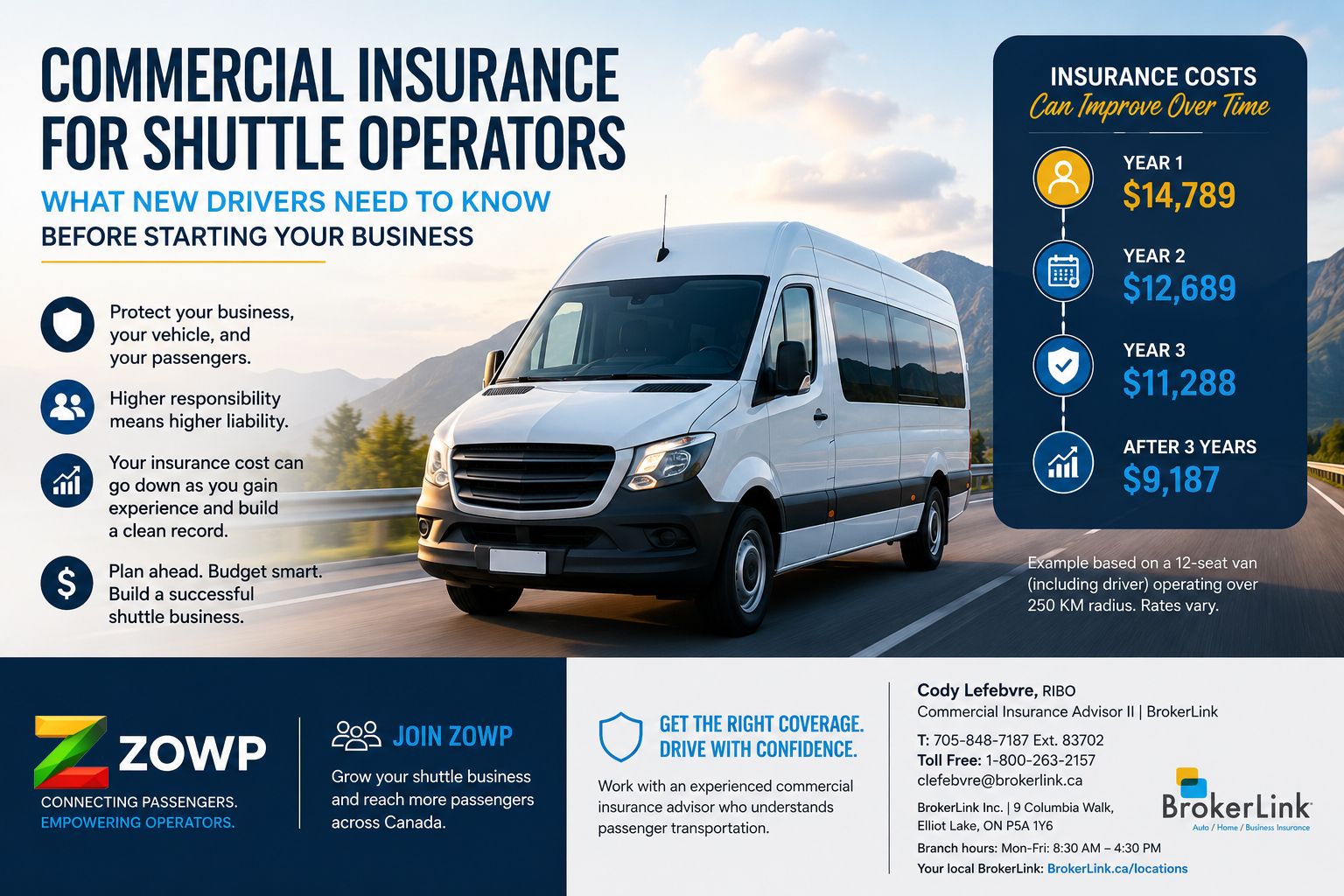
The good news is it comes down as you build a clean record. Here's an example of how premiums can drop for a new 12-passenger operator:
Year
Approx. annual premium
First year
$14,789
After 1 claim-free year
$12,689
After 2 claim-free years
$11,288
After 3 claim-free years
$9,187
Your real number depends on your location, vehicle, passenger capacity, driving history and coverage limits, so get an actual quote from Cody before you commit to anything.
And please: don't try to run paying passengers on a personal auto policy. If the insurer finds out, they can deny the claim or cancel the policy, and you're personally on the hook for the damages.
Step 4: Finance and buy your van
Now that your CVOR is coming and you know your real insurance cost, you can shop with a realistic budget.
Already found your van? Call Rony at Autobase. They can finance it for you.
Haven't found one yet? Call Rony anyway. They'll help you find a van that fits your budget.
Rony's contact info is in the free PDF too.
Step 5: Get your safety inspection (the yellow sticker)
Once the van is bought and insured, it still can't carry passengers until it passes a commercial safety inspection. That's the yellow inspection sticker.
Cost: about $800 to $1,000 per inspection.
How often: every 6 months.
That's up to $2,000 a year just to stay inspected, so put it in your budget from day one.
Step 6: Set up your ELD and dash cam
You'll also need an ELD (electronic logging device) to track your hours of service.
Fair warning: this part is annoying. Most ELD companies hide their pricing. You have to message their sales team just to find out what it costs, and then they follow up forever. If you want to shop around, create a separate email just for vendor quotes so your real inbox doesn't get buried.
Or skip all that. Here are the two I liked:
Motive: about $100 a month for the ELD and the dash cam together. The AI assist is great if you have employees. It flags when drivers aren't following your rules, so you don't have to sit there watching camera footage.
RAM Tracking: about $40 a month for the ELD and $25 a month for the dash cam.
For both, the hardware is sold separately at around $300 to $400, and you have to sign up for a 1-year plan. That's still better than a lot of other companies, which want a 3-year commitment.
Step 7: Start small and protect your record
A few things that'll keep your costs down in the first years:
Start with a manageable route. Shorter routes mean less fuel, less wear and less exposure while you build demand.
Protect your driving record like it's your business, because it is. No accidents, no claims, no tickets. Every clean year makes your next renewal cheaper.
Use that dash cam. It protects you against false claims and shows insurers you take safety seriously.
What to budget for beyond the van
The van and insurance are the big ones, but they're not the only ones:
Vehicle: financing payments, commercial registration, maintenance, tires, brakes, safety inspection every 6 months ($800 to $1,000 each)
Operating: fuel (you'll drive thousands of km a month), oil changes, cleaning, surprise repairs, ELD and dash cam plans ($65 to $100 a month plus $300 to $400 in hardware)
Admin: incorporation, CVOR, accounting software, banking fees
Getting passengers: website, ads, social media, partnerships
Booking software: a way to take bookings, collect payments and manage your passengers
That last one is exactly why I built Zowp. More on that below.
Get the free Operator Starter Kit
I put together a free Operator Starter Kit with the direct contact info for the insurance broker and the van financing contact I used to get my shuttle on the road, plus a one-page checklist of the steps above in the right order.
To get it, sign up as an operator on Zowp. Once you're registered, we'll send the Starter Kit straight to you.
Become a shuttle operator with Zowp
Getting compliant is the hard part. Filling your seats shouldn't be.
Zowp is the platform I built for independent shuttle operators like me. It helps you manage bookings and passengers, track your sales, organize your trips, and get in front of people who are already looking for a ride.
Whether you're still waiting on your CVOR or you've been on the road for years, I'd love to have you on board.
[ Join Zowp as an operator ]
This guide is based on my own experience in Ontario as of 2026. Fees, timelines and insurance pricing change, so always confirm with the MTO and a licensed insurance broker before making decisions.
Comments
No comments yet. Be the first to share your thoughts.
Log in to join the conversation.